Flutter vs. React Native in 2026: Which Framework Should You Choose for Your Mobile App?
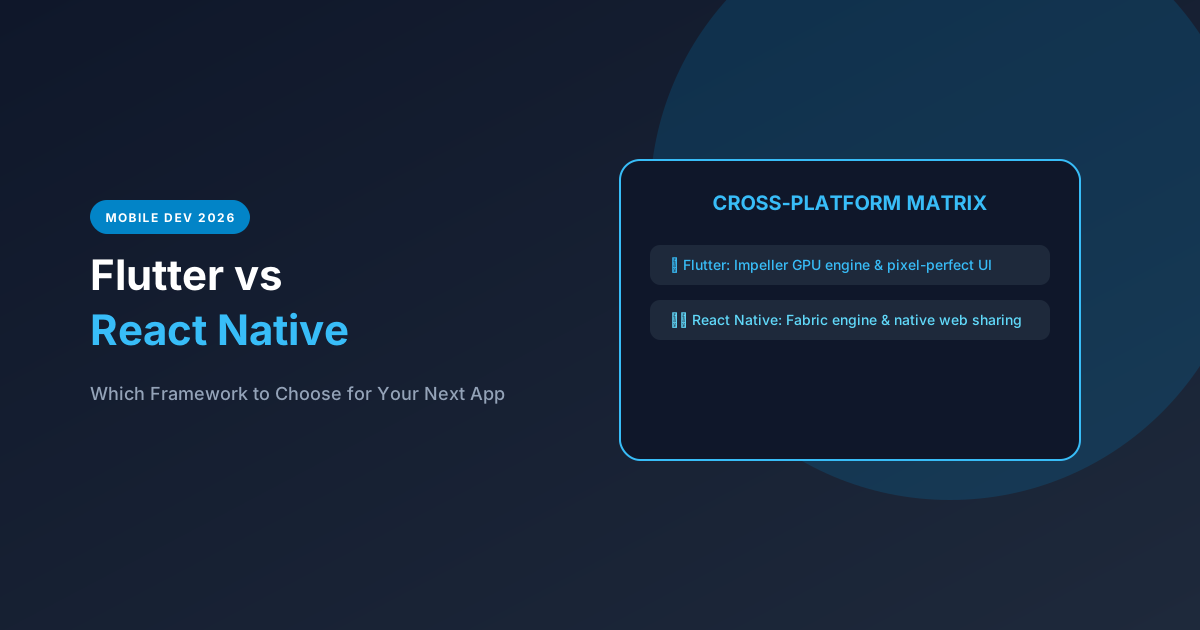
When building a mobile application in 2026, writing separate native codebases in Swift for iOS and Kotlin for Android is rarely cost-effective for startups and growing enterprises. Cross-platform mobile development allows engineering teams to ship high-performance iOS and Android apps from a single codebase.
The two undisputed leaders in cross-platform mobile app development are Google's Flutter and Meta's React Native.
If your business is planning a new app launch, partnering with an experienced agency for Mobile App Development ensures you choose the right framework for your product roadmap.
---
1. Architecture & Rendering Engine Comparison
Flutter (Powered by Impeller) Flutter does not rely on native system UI components. Instead, it renders every pixel directly using its custom vector engine (Impeller). * Advantage: Your app looks and behaves identically on every device, operating system version, and screen size. * Performance: Smooth 60fps to 120fps animations without micro-stutters or frame drops.
React Native (Powered by New Architecture - Fabric) React Native uses native UI components wrapped in JavaScript bridge interfaces. * Advantage: Controls feel truly native because they *are* native system controls (e.g. native iOS pickers or Android text inputs). * Performance: React Native's Fabric renderer replaces legacy bridges with direct C++ bindings, delivering near-native performance for data-heavy apps.
---
2. Head-to-Head Feature Comparison
| Feature | Flutter | React Native | | :--- | :--- | :--- | | Backing Tech Giant | Google | Meta (Facebook) | | Programming Language | Dart | JavaScript / TypeScript | | Code Reusability | ~90% across Mobile, Web, Desktop | ~85% across iOS & Android | | UI Customization | Exceptional (Custom Canvas) | Great (Native Look & Feel) | | Hiring Pool | Rapidly Growing | Massive (React Ecosystem) | | Best For | Custom UIs, Fintech, E-Commerce | Social Apps, Marketplace Platforms |
---
3. Which Framework Should Your Business Pick?
Choose Flutter If: * You require bespoke, brand-heavy visual designs that look identical across iOS and Android. * You plan to extend your mobile app to desktop or web apps in the future using Flutter Technology. * You want to hire pre-vetted engineers. You can hire senior developers directly through our Hire Flutter Developers portal.
Choose React Native If: * You already have a web application built in React or Next.js and want to share state logic, API calls, and developer knowledge between web and mobile. * You need access to specialized native mobile plugins. You can scale your engineering capacity through our Hire React Native Developers service.
---
Making Your Decision
Both Flutter and React Native are production-tested technologies capable of supporting millions of active users. The decision ultimately comes down to your visual design goals, team skillset, and long-term tech stack ecosystem.
Have a mobile app concept to build? Reach out to our team via our Contact Page for a free technical consultation.
Mr. Vyas
Founder & Lead Tech Architect at Bliss Technologies. Specialist in Enterprise AI RAG pipelines, Next.js 15, high-availability mobile backends, and cloud DevOps architectures.
Frequently Asked Questions
Is Flutter faster than React Native in 2026?
With Flutter's Impeller rendering engine, Flutter delivers smooth 60fps/120fps graphics performance. However, React Native's New Architecture (Fabric + TurboModules) has closed the performance gap for most standard business apps.
Which framework is better for cross-platform iOS and Android apps?
Both frameworks achieve 85%+ code sharing between iOS and Android. Flutter is preferred for custom, UI-heavy apps, while React Native is ideal for teams with existing React web developer experience.
Can I convert a React Native app to Flutter or vice versa?
Converting requires rewriting UI and state logic, but backend REST APIs, authentication endpoints, and database schemas remain unchanged.
How much cost can cross-platform app development save?
Building a single cross-platform codebase in Flutter or React Native saves up to 40% in initial development costs compared to writing separate native Swift (iOS) and Kotlin (Android) codebases.
Which framework has a larger developer market?
React Native benefits from the vast global React ecosystem, making hiring developers easy. Flutter has grown rapidly in popularity due to Google's continuous investment and clean Dart language design.
Related Articles & Insights
View All Articles →
How AI Agents Are Transforming Customer Support in 2026